Tuesday, March 1, 2011

Elegant Art Jokes: THE LABYRINTH OF EGYPT

A labyrinth, with the ancients, was a building containing a great number of chambers and art painting techniques galleries, running into one another in such a manner as to make it very difficult to find the way through the edifice. The most famous was the Egyptian labyrinth, situated in Central Egypt, above Lake Moeris, not far from Crocodilopolis, in the country now called Fejoom. Herodotus, who visited and examined this edifice with great attention, affirms that it far surpassed everything he had conceived of it. It is very uncertain when, by whom, and for what purpose it was built, though in all probability it was for a royal sepulchre. The building, half above and half below the ground, were one of the finest in the world, and is said to have contained 3,000 apartments. The arrangements of the work and the distribution of the parts were remarkable. It was divided into sixteen principal regions, each containing a number of spacious buildings, which taken together, might be defined an assemblage of palaces. There were also as many temples as there were gods in Egypt, the number of which was prodigious, besides various other sacred edifices, and four lofty pyramids at the angles of the walls. The entrance was by
vast halls, followed by saloons, which conducted to grand porticos, the ascent to which was by a flight of ninety steps. The interior was decorated with columns of porphyry and colossal statues of Egyptian gods with various painting colors. The whole was surrounded by a wall, but the passages were so intricate that no stranger could find the way without a guide. The subtractions of this famous labyrinth still exist, and Milizia says, “as they were not arched, it is wonderful that they should have been so long preserved, with so many stupendous edifices above them.” The Cretan labyrinth was built by Dædalus on the model of the Egyptian, but it was only a hundredth part the size; yet, according to Diodorus Siculus, it was a spacious and magnificent edifice, divided into a great number of apartments, and surrounded entirely by a wall. What would the ancients say; could they see our modern imitations of their labyrinths?

Artist Networking Sites – Promote Yourself!!!


In this day and age when millions of average people across the globe are feeling isolated and are reaching out to each other through social networking sites such as MySpace, Facebook and Friendster and other similar sites, there are emerging social networking sites for groups of people based on their professions like musicians, artists, actors and business people as well as social networking sites for groups based on their hobbies. This is a new and rapidly growing phenomenon on the internet. Artists need a place to show off their creative talents and see what other artists are up to and to just hang out and chill and chat with other artists and make new contacts and make new friends. There is a new and rapidly growing Artists Networking Site and Online Gallery called My Art Friends on the web and it is similar in many ways to MySpace and Facebook in that you can make your own profile page, add friends, make new friends and contacts with other artists from around the world, upload photos of yourself and your artwork, upload videos, upload music, blog, participate in groups, create groups, participate in forums, chat with other members and Post Classified ads. Are you an artist feeling isolated (like a lot of people these days) and want to join a community of people with similar interests and a passion for art? You should join an Artists networking site like and share your art with the world. Its fun, it’s easy and it’s FREE. You can even use it as your own personal website and link it to other sites you are on. So go ahead, become a part of the new and growing web phenomena – Social Networking Sites. Be like me and join about 10 or 15 different sites as a way to promote your artwork. I was contacted by an Art Consulting Group on one artist networking site and they just sold four of my paintings realistic, so it’s another way to promote and sell your artwork. Be there or be square.Article by George McKim George McKim is an award winning Fine Art Painter with an MFA from ECU, a BFA from VCU and Post Graduate study at Skowhegan School of Painting and Sculpture. His art painting techniques has been exhibited in galleries and museums across the country.

Later history


Widely admired during the Terror whose leaders ordered several copies of the original work (copies made in 1793–1794 by David’s pupils to serve propaganda), The Death of Marat slowly ceased to be ‘frontpage history’ after Robespierre’s overthrow and execution. At his request, it was returned to David in 1795, himself being prosecuted for his involvement in the Terror as a close friend of Robespierre (he would have to wait for Napoleon’s rise to become prominent in the arts once more). From 1795 to David’s death, the paintings realistic languished in obscurity. During David’s exile in Belgium, it was hidden, somewhere in France, by Antoine Gros, David’s dearest pupil. In 1826 (and later on), the family tried to sell it, with no success at all. It was rediscovered by the critics in the mid-nineteenth century, especially by Charles Baudelaire whose famous comment in 1846 became the starting point of an increased interest among artists and scholars. In the 20th century, the painting inspired several painters (among them Picasso and Munch who delivered their own versions), poets (Alessandro Mozzambani) and writers (the most famous being Peter Weiss with his play Marat/Sade).
The original painting techniques are currently displayed at the Royal Museum of Fine Arts in Brussels, being there as a result of a decision taken by the family to offer it, in 1886, to the city where the painter had lived quietly and died in exile after the fall of Napoleon. Some of the copies (the exact number of those completed remains uncertain) made by David’s pupils (among them, Serangeli and Gérard) survived, notably visible in the museums of Dijon, Reims, and Versailles. The original letter, with bloodstains and bath water marks still visible, has survived and is currently intact in the ownership of Robert Lindsay, 29th Earl of Crawford.
Other artists have also depicted the death of Marat, sometimes long after the facts, whose works refer or not to David’s masterpiece. Among these later works, the Charlotte Corday by Paul Jacques Aimé Baudry, painted in 1860, during the Second Empire, when Marat’s “dark legend” (the angry monster insatiably hungry for blood) was widely spread among educated people, depicts Charlotte Corday as a true heroine of France, a model of virtue for the younger generations. The versions of Picasso and Munch are less trying to refer to the original context in itself than to confront modern issues with those of David, in terms of style.


Style


Marat’s figure appears quite idealized. For example, the painting techniques contain no sign of his skin problems. David, however, drew other details from his visit to Marat’s residence the day before the assassination: the green rug, the papers, and the pen. David promised his peers in the National Convention that he would later depict their murdered friend invocatively as “écrivant pour le bonheur du peuple” (writing for the good of the people). The Death of Marat is designed to commemorate a personable hero. Although the name Charlotte Corday can be seen on the paper held in Marat’s left hand, the assassin herself is not visible. Close inspection of this painting shows Marat at his last breath, when Corday and many others were still nearby (Corday did not try to escape). Therefore, David intended to record more than just the horror of martyrdom. In this sense, for realistic as it is in its details, the painting, as a whole, from its start, is a methodical construction focusing on the victim, a striking set up regarded today by several critics as an “awful beautiful lie”— certainly not a photograph in the forensic scientific sense and barely the simple image it may seem (for instance, in the painting, the knife is not to be seen where Corday had left it impaled in Marat’s chest, but on the ground, beside the bathtub).
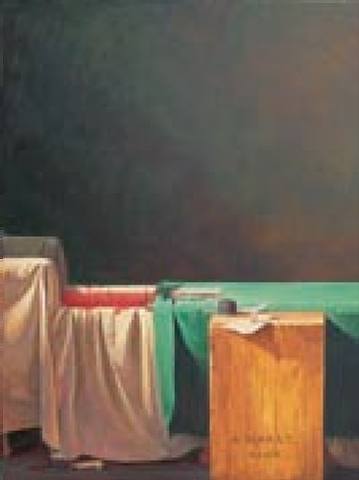
Yue Minjun, The Death of Marat

The Death of Marat has often been compared to Michelangelo’s Pietà. Note the elongated arm hanging down in both works. David admired Caravaggio’s works, especially Entombment of Christ, which mirrors 

David sought to transfer the sacred qualities long associated with the monarchy and the Catholic Church to the new French Republic. He painted Marat, martyr of the Revolution, in a style reminiscent of a Christian martyr, with the face and body bathed in a soft, glowing light. As Christian Art painting techniques had done it from its beginning, David also played with multileveled references to Classical Art. Suggestions that Paris could compete with Rome as Capital and Mother City of the Arts and the idea of forming a kind of new Roman Republic appealed to French Revolutionaries, who often formed David’s audience.

The Death of Marat by Jacques-Louis David and quote by fashion photographer Eugenio Recuenco


The Death of Marat by Jacques-Louis David

The Death of Marat (French: La Mort de Marat )
is really a 1793 painting inside the Neoclassic art painting techniques by Jacques-Louis David, it really is probably the most famous images of the French Revolution. This work refers to the assassination of radical journalist Jean-Paul Marat, killed on the 13th of July 1793 by Charlotte Corday, a French Revolutionary figure from the minor aristocratic family. Corday, who blamed Marat for the September Massacres and feared an exciting out civil war, claimed “I killed one man in order to save 100,000.”
La Mort de Marat Jacques - Louis David
plus a quote by fashion photographer Eugenio Recuenco


The Death of Marat by Eugenio Recuenco 

Jean-Paul Marat (24 May 1743 - 13 July 1793),
would be a Swiss-born French physician, philosopher, political theorist and scientist most widely known being a radical journalist and politician from the French Revolution.
Marat often sought
a chilly bath to help ease violent itching due to a skin disorder long said to have been contracted years earlier, when he was instructed to hide from his enemies within the Paris sewers.
David
was obviously a good friend of Marat, in addition to a strong supporter of Robespierre as well as the Jacobins. Because of his difficulty speaking (he previously a benign but large facial tumor, caused by a personal injury sustained while fencing); David was at a loss for their natural ease of convincing crowds making use of their speeches. Determined to memorialize his friend, David painted this impressive painting techniques of Marat.